Pinewood Derby Rules
1. GENERAL RULES AND REGULATIONS
The following Rules and Regulations apply to all Pinewood Derby Race Events.
Each Scout is responsible for understanding and following all rules. Nothing would be more heartbreaking than to work hard on a car and then have it disqualified for a rule violation. Parents: please review the rules with your Scout and help them understand the regulations, science, and sportsmanship of the Pinewood Derby.
1.1 Qualification to Race
- All registered Cub Scout members – Lions through Arrow of Light may design, build, and enter one eligible car to participate in the "Cub Scout Pinewood Derby Race" event.
- Siblings of the registered Scout may also enter a car to race for a fee of $7 per car. Only registered Cub Scouts, not siblings, will be eligible for trophies, medals, and certificates. Adults may enter the "Adult Outlaw Class" for a fee of $10 per car, which covers the cost of the car and a Pack donation. Adults in this class are eligible for first and second-place trophies.
1.2 Essential Materials
- All cars entered shall be constructed from the "Official Pinewood Derby Kit" produced and sold by the BSA (referred to herein as the kit). PineCar® or any other brand kits, blocks of wood, pre-cut bodies, axles, or wheels are not permitted. PineCar or any other brand add-ons and weights are permitted.
1.3 Attendance
- The Cub Scout MUST register/enter their own car for competition. This means that the Cub Scout must be present at the "Inspection and Registration" process to enter their car into competition. Any exceptions must be cleared by the Key 3.
1.4 New Work
- The car must be newly constructed each year.
- Modifications to previous year's cars will not be accepted.
- Purchased pre-cut and/or assembled cars will not be accepted.
1.5 Failure to Pass Inspection
- The Official Inspection Committee shall be responsible to inspect and to disqualify any car that does not meet the rules as described herein.
- If a car does not pass inspection, the owner will be informed of the reason their car did not pass.
- Cars that fail the initial inspection may be taken for modifications and brought back no later than the close of registration for final inspection and registration.
- After a car is registered and passes inspection, it will be impounded & stored by the Pinewood Derby Race Committee until race day/time.
- No car may be altered in any way after it has been registered unless repairs are necessary during the race. See Section 3
- After this point the only persons allowed to handle the cars will be a member of the Pinewood Derby Race Committee.
2. CUB SCOUT RACE CAR DESIGN REGULATIONS
2.1 Overall Car Specifications
- Maximum Overall Width (outside edge-to-edge of wheels): 2-3/4"
- Minimum Width between wheels: 1-3/4"
Inside & Outside Wheel Specifications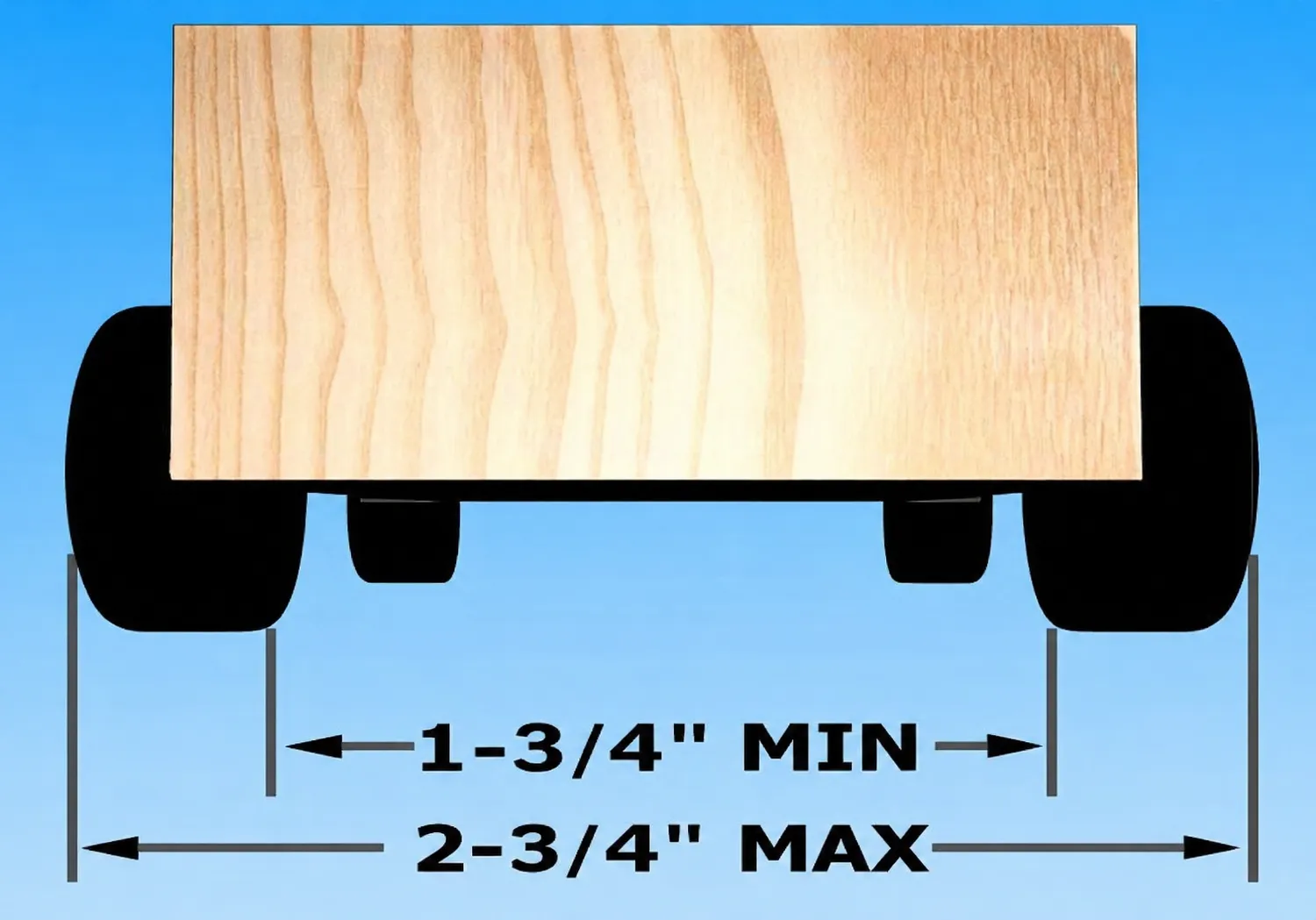
- Wheelbase: The distance (4-3/8") between axles must not be changed.
- Maximum Length: 7"
- Maximum Height: 5"
Length, Height, Wheelbase, & Clearance Requirements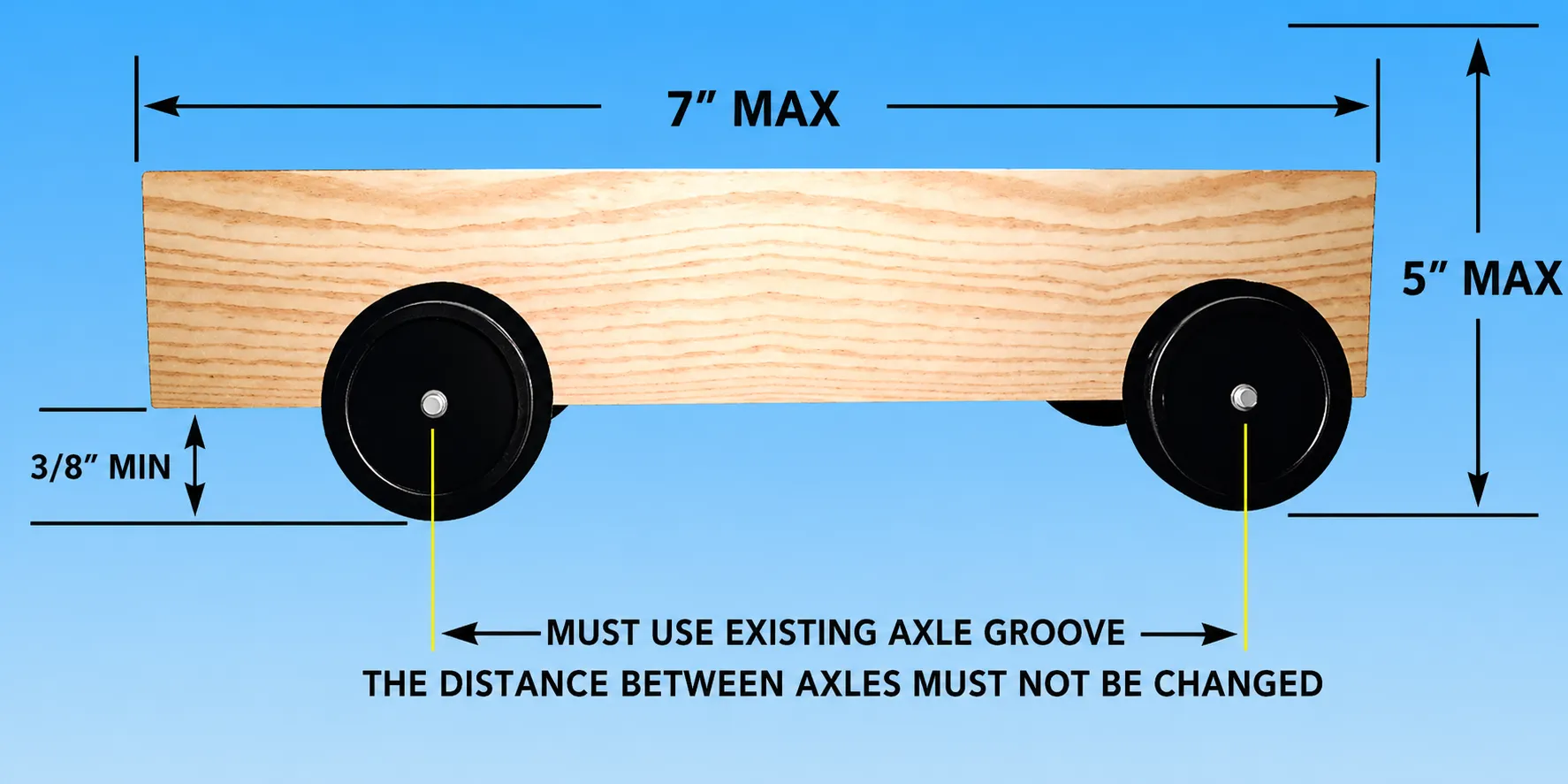
- Minimum Track Clearance: Bottom clearance between car and track must be at least 3/8"
Even though the lane strips are typically only 1/4" high. The extra clearance is to allow the car to go from the sloped portion of the track to the flat portion without dragging.
- Front of Car: The minimum front nose width shall be at least 1/2" and parallel with the front axle to operate properly on the track. Nothing on the car shall extend beyond the nose of the car.
- Maximum Weight: Not over 5.00 Ounces (141.75 grams) as determined by the official scale.
2.2 Material
- Race cars shall be constructed for this event from the parts contained in the Official BSA Pinewood Derby Kit (referred to herein as the kit) as sold by the local Scout Shop or Scoutshop Online. This kit includes the wooden block with precut axle slots, 4 plastic wheels and 4 metal nails to be used for axles.
- Molded metal bodies over wooden frames are beyond most parent/Scout teams and are therefore not acceptable.
- Materials from the kit may be supplemented but not replaced. The main body must be constructed from the wood in the kit.
- "Add-ons" are not restricted as long as they meet with the rules and regulations as specified within this document and the original kit is used. All add-ons must be secure.
- Special paint, decals, decorations, etc. are allowed.
- Unofficial kits will not be accepted. The PineCar® Pre-Cut Design bodies will not be allowed to enter the Pinewood Derby Event.
- Official BSA stamped colored (blue, red, orange, yellow, pink, purple, green, etc.) wheels will be acceptable. These must have the "Official BSA" lettering in the mold.
2.3 Weight
"Weight" is considered to be any material on the car that is added in addition to the kit.
- Cars may weigh no more than five (5.00) ounces (141.75 grams) total weight (kit plus add-ons) as determined on the official scales during the pre-race registration/inspection. While there is no minimum, at least 3.5oz is needed to cross the finish line.
- Weight may be added to the car and will be considered part of the car for purposes of all measurements.
- The car may be drilled/hollowed out and weight must be securely added.
- No liquid weights are permitted inside or attached to the outside of the car body.
- No weights may be added after the car has been registered, inspected, and impounded for the event race.
- All weight must be securely fastened to the car, e.g. by permanent glue, nails or screws, NO "sticky substances", e.g. tape, tack spray, wet glue. Heavy-duty double-sided tape such as that used by the ones sold by BSA - Stick-On Weights (WW7603) will be allowed. Putty weights are acceptable as long they do not interfere with clearance or other cars. Putty may not be on the front of the car as to interfere with the starting mechanism.
- Weights shall be passive, i.e. non-moveable, non-magnetic, non-electric.
The official scale will be available before the date of the event as well as during the registration process.
If you are unable to check the weight of your car on the official scale prior to registration, then it would be a good idea to be slightly under weight on any other scale you are using. On inspection day, it is typically easier to add weight than it is to remove weight.
2.4 Wheels and Axles
-
All cars must have four (4) wheels. All four wheels must be installed in the provided axle slots. The car shall roll on all four (4) of the wheels from the official kit or official BSA wheels.
-
All four wheels MUST be in contact with a flat surface when the car is placed on it. Wheels should be aligned so that the complete surface of the wheel is in contact with the track (not cambered in or out and axles not bent).
-
The wheels shall turn about the axle nails from the official kit. It must be obvious to the judges that the precut grooves in the wooden block, wheels, and the nails from the kit are being used. No "after market" (purchased modified) wheels or axles are allowed. No shaving of the wheels (inside or out) to remove mass is allowed.
-
Only official BSA wheels and axles may be used as replacements.
-
The wheel base (distance between the axles) must not be changed from the standard locations of the official car kit.
-
Hubcaps/wheel covers are not allowed.
-
The axle nails shall be firmly affixed to the wood of the car body, and MUST be placed in the original 'axle grooves' in the supplied wooden block.
-
The axles provided may ONLY be altered in the manner as to remove the metal mold imperfections near the nail head. The axles may be polished and lubricated. ONLY dry lubricants may be used.
-
Axles may not be angled in the car body slots in a manner that would cause the wheel not to run flat to the surface of the track.
-
The axles head and shaft diameter may not be modified or reduced.
-
The shape and form of the wheels cannot be modified or reshaped, however wheels may be sanded to remove molding burrs. Wheels may not be tapered or rounded.
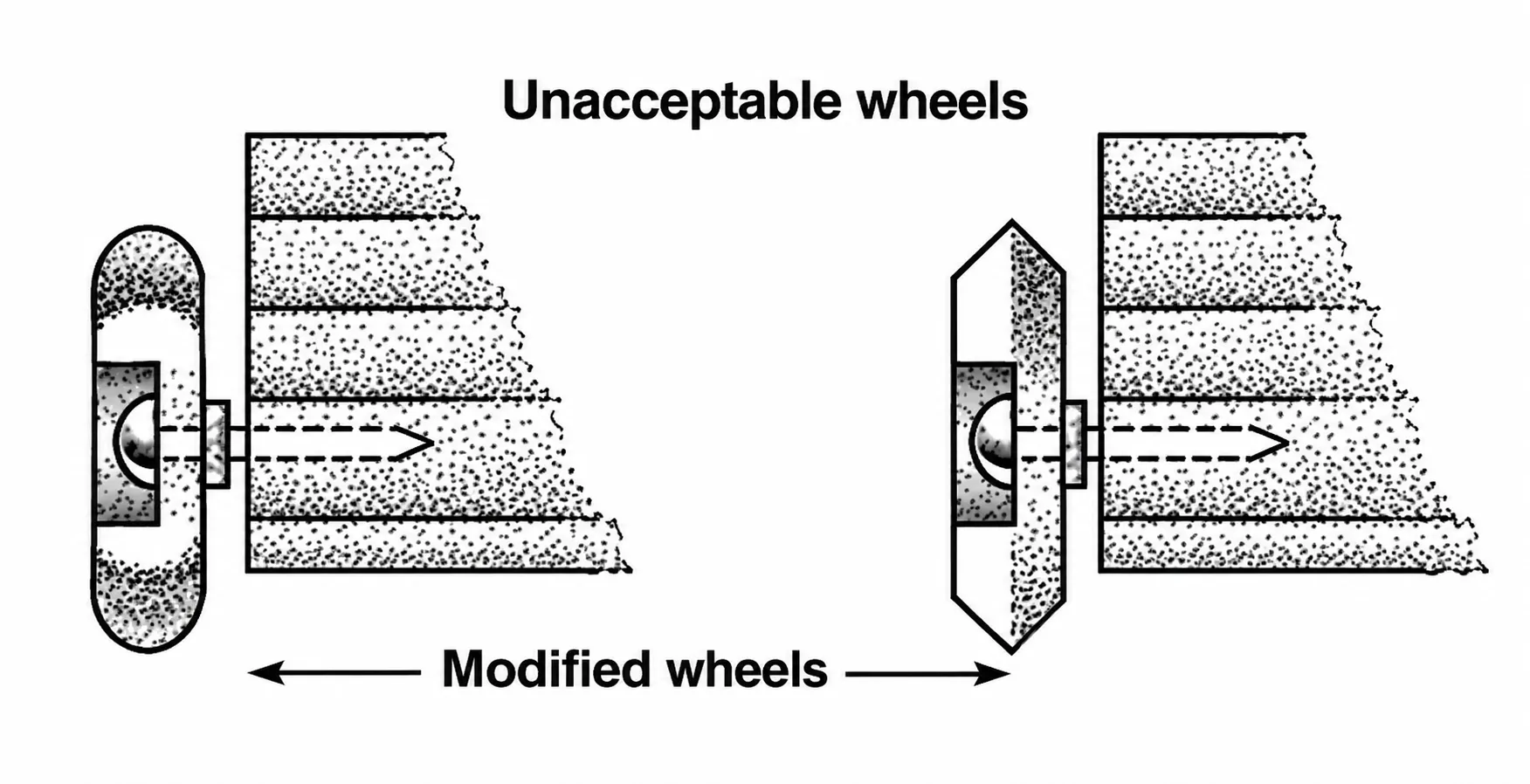
Example of Rule Breaking Modified Wheels
-
Wheel treatment (hub and tread smoothing and polishing) may not result in substantial removal of mass nor in reducing the wheel width from the original kit wheels.
-
Regarding wheel smoothing, the inside and outside of the wheel and hub may not be altered or modified in any way (i.e., no material removed from the inside of the wheel) with the exception of the removal of the burrs and molding marks on the outside of the tread. The wheels may not be cut, drilled, beveled, tapered, thin sanded, wafered, lathe turned or rounded.
-
Some of the original "tread marks" on the wheel face must remain intact, i.e. apparent to the inspector. The lettering "Official BSA" on the inside/outside of the wheel must be clearly visible.
-
It must be obvious to the inspection committee members that the axle grooves, wheels and the axles provided in the kit are being used.
2.5 Lubricants
- The wheels and axles may be lubricated with powdered white teflon lube or dry powdered graphite. Only dry lubricants may be used. If a liquid lubricant is used, the car will fail inspection, will not be able to be cleaned to pass inspection, and will not be allowed to touch the track.
- Lubricants may not foul the track.
- Lubrication will only be allowed prior to registration. Once inspection is completed, no additional lubrication will be allowed.
- If wheel or axle repairs are necessary during the race, only the replacement part may be re-lubricated under the supervision of a race official.
2.6 Unacceptable Construction
- The following may not be used in conjunction with the wheels or axles:
- Hubcaps
- Washers
- Inserts
- Sleeves
- Bearings
- No loose material of any kind is permitted in or on the car.
2.7 Gravity Powered
- The race car may not be constructed or treated in such a way that the track's starting mechanism imparts momentum to the car.
- Cars with sticky substances on the front of the car and protrusions which may catch on the starting pin shall be disqualified.
- The car shall not run on any type of springs.
- The car must be freewheeling with no starting devices.
- No external sources of power, magnets, engines, jets, compressed air or propulsion systems other than gravity may be used.
- If the track's electronic finish line sensor's result is challenged by the Finish Line Judges only, the race will be re-staged and re-run
3. RACE DAY RULES, REGULATIONS, AND INFORMATION
Competition will consist of heat races with both Cub Scouts and Sibling cars racing. Each car will run 4 heats on race day. Each car will run down each numbered lane once on race day. Race Committee Key 3 are responsible for the proper conduct of the races. The decisions of the Race Committee Key 3 are deemed final.
3.1 Check-in and Racing
- The Cub Scout is expected to race their car. If due to illness or other valid reason, the scout is unable to race their car, another child may drive their car with the approval of the Race Committee.
3.2 Inspection Gauges
- The race-day "Inspection and Car Registration" area will have the official scales, length boxes and other measurement tools necessary to inspect the cars.
- The check-in equipment used during the Inspection and Registration of cars shall be the official equipment for the race.
- Check Weights used for scale calibration in pre-race check-in will also be available on race day.
3.3 Race Day Lubrication
- All Lubrication must be done prior to registration/inspection. NO graphite will be allowed during the Pinewood Derby Race. If you are found trying to add additional graphite during the race, it will result in disqualification.
3.4 Car Leaves Lane or Track Prior to Crossing the Finish Line
- If, during a race heat, a car leaves its lane but proceeds down the track in a manner that does not interfere with its opponent, the racer will be given 2 minutes to inspect and/or repair car, re-qualify and the race will be re-staged and re-run.
- If the car leaves its lane and interferes with another car, the racer will be given 2 minutes to inspect and/or repair car, re-qualify and the race will be re-staged and re-run.
- If a car continues to leave its lane during racing and is not able to be repaired such that it no longer leaves the lane, that car will not be allowed to race that heat and will get a time of 9.9999999 seconds for that heat. Additional times of 9.9999999 seconds will be used for each additional heat.
- If, during a race heat, a car leaves the track prior to crossing the finish line without interfering with its opponents, the racer will be given 2 minutes to inspect and/or repair car, re-qualify and the race will be restaged and re-run.
- If the same car again leaves the track without interfering with its opponents, that car will have a time entered of 9.9999999 seconds.
3.5 Car Does Not Cross the Finish Line
- If, during a race heat, a car does not cross the finish line, did not interfere with another car, and remained on the track, then a time of 9.9999999 seconds will be entered.
3.6 Car Repair (Without Fault)
- If, during the race, a wheel falls off or the car becomes otherwise damaged, then the Scout may, to the best of their ability perform repairs with the assistance of their adult partner.
- The Racer and adult partner shall be allowed 2 minutes to perform repairs and re-qualify for racing. This time may be extended upon the approval of the Trackmaster.
- The car shall be re-qualified for racing in accordance with Rules within this document.
3.7 Car Repair (With Fault)
- If a car is damaged due to track fault, or damage caused by another car or person, then the Trackmaster, at their sole discretion, may allow additional repair assistance and time to the Cub Scout and adult partner.
- The car shall be re-qualified for racing in accordance with Rules within this document.
3.8 Race Area
- Only members of the Race Day Committee and Staff may enter the track area on race day.
3.9 Rewards and Recognition
The most important values in Pinewood Derby competition are parent/Scout participation, good sportsmanship and learning how to follow rules. The Awards Committee is responsible for recognizing and encouraging these qualities in addition to traditional racing awards. Racers will be recognized as follows:
- Every participating Scout will receive a Pinewood Derby participation patch that can be worn on their uniform.
- Standings are based on the average of fastest three times submitted for each
car. The slowest time for each car will not be used. Tie breakers will only
be done for the Top 3 in Pack, Top 3 in Den, and Top 2 in Outlaw. Tie
breakers are:
- Fastest heat
- Average of 2 fastest heats
- 2nd fastest heat
- 3rd fastest heat
- Average of 3 Fastest Heats to 5 decimals
- Trophy awards and medals will be given for the overall First, Second, and Third place finishers.
Trophies & Certificates will be awarded for Best in Show, Best Workmanship, Most Creative, Most Humorous, Most Futuristic, Best Vehicle Not a Car, and Cubmaster’s Choice. All categories that are not speed related will be judged by special guests and Scouts BSA Scouts and Leaders before the race starts with the exception of Cubmaster’s Choice. Only those Troop members who do NOT have a sibling in our Pack will be allowed to judge cars. Other judges may be appointed by Pinewood Derby Committee.
4. ADULT OUTLAW CLASS
Competition will consist of heat races. Each car will run 4 heats on race day. Each car will run down each numbered lane once on race day. Race Committee members are responsible for the proper conduct of the races. The decisions of the Race Committee Key 3 are deemed final.
4.1 General Rules
- Each car must pass inspection by the official Derby Inspectors before it will be allowed to compete. The Derby Inspectors have the right to disqualify any car that does not meet the specifications stated in this document. If at inspection a car does not pass, the owner will be informed of the observed problems and will be given until the end of the official registration period in which to correct the problem. If the car fails inspection the owner must fix it and then wait in line for another inspection. After inspection all cars will be impounded until the start of the derby. Once it is impounded, it cannot be handled again by racers until the derby has ended (no exceptions).
4.2 Overall Car Specifications
- Cars must be made from the official BSA Pinewood Derby car kit from our Pack. The car design may be enhanced by the addition of other stable materials such as plastic or metal. Any additions must be firmly attached and meet car size requirements. Pre-cut, or purchased cars are not permitted.
- Cars must comply with the following specifications:
- Weight: Cars must weigh no more than 8.0 ounces (226.80 g) as measured on the official scale at weigh-in night. While there is no minimum, at least 3.5oz is needed to cross the finish line.
- Width: The maximum width of the car, including wheels and axles, must not exceed 2-3/4 inches.
- Height: The maximum height of the car must not exceed 5"
- Bottom Clearance: The distance between the bottom of the wheels and the bottom of the lowest point of the car other than the wheels must be at least 3/8 inch.
- Width Between Wheels: The distance between the innermost edges of the left and right wheels must be at least 1-3/4 inches.
- Wheelbase: There is no restriction on the distance between the front and rear axles.
- No part of the car may protrude beyond the starting peg or gate.
- The following items are prohibited:
- Starting devices or propellants (A starting device is something that alters the rotation or spin of the wheel.)
- Liquids, wet paint, oil, sticky substance, or powders of any kind (other than dry axle lubricant)
- No part of the car, other than wheels, may be capable of contacting any part of the track, other than the starting peg or gate.
- Wheels may be modified by the racer but must display BSA logo. All 4 wheels do NOT have to be in contact with flat surface when placed on it.
- Axle placement may be altered. Front and rear axle locations can be moved. You don’t have to use the precut slots in the pinewood block for axle placement.
- All wheels and axles must be official BSA and cannot be purchased pre-modified from third parties.
4.3 Prizes
Trophy and certificate will be awarded for overall 1st and 2nd place finishers.